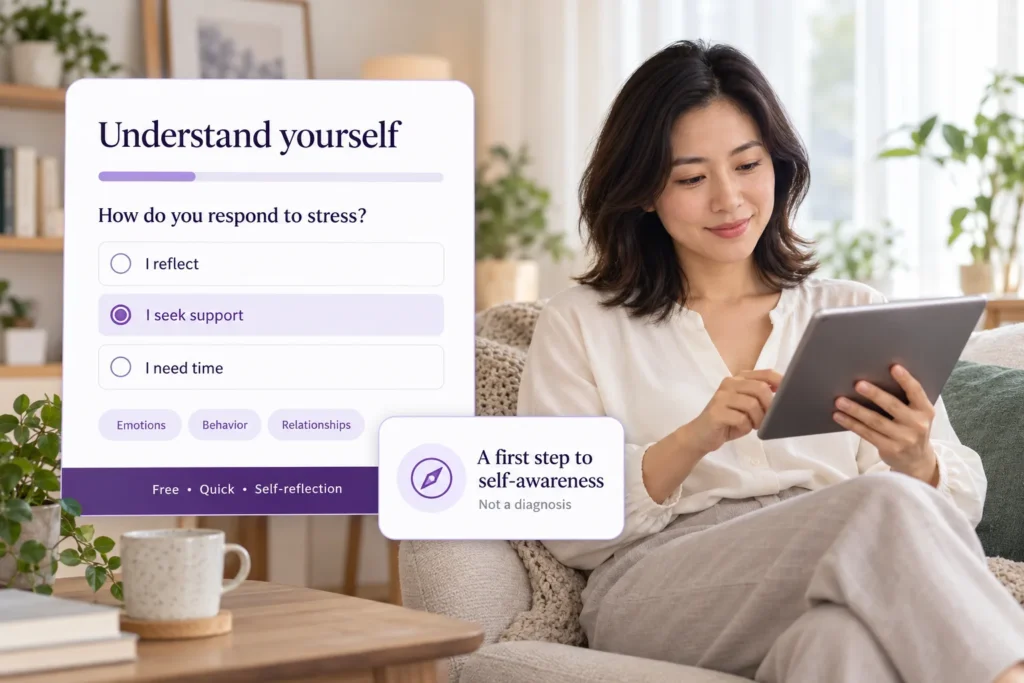

Do you often feel like others are out to get you, even when there's no clear reason? This test explores signs of deep suspicion and mistrust that could point to paranoid thinking patterns.
Paranoid Personality Disorder TestFree, expert-designed screeners for the ten DSM-5-TR personality disorders and the trait patterns around them. Each gives an instant, plain-language result and points you toward what to do next.
A personality disorder is an enduring pattern of inner experience and behaviour that differs markedly from what’s expected in a person’s culture, is pervasive and inflexible, begins by adolescence or early adulthood, is stable over time, and leads to distress or problems in daily life. It’s not a passing mood or a reaction to one situation — it’s a long-standing way of perceiving, feeling and relating that shows up across many areas of life.
According to the DSM-5-TR, these patterns appear in at least two of four areas: cognition (how you perceive yourself, others and events), affectivity (the range, intensity and stability of emotions), interpersonal functioning, and impulse control. Personality disorders affect roughly one adult in ten and — crucially — they are treatable. A personality disorder is something a person has, not something they are.
Personality disorders share a recognizable set of general signs, regardless of the specific type. You don’t need all of them, and having some doesn’t mean you have a personality disorder — but the more that feel like long-standing, pervasive patterns, the more a professional conversation may help.
The patterns aren’t recent or situational — they’ve been part of how you operate since adolescence or early adulthood, and have stayed fairly consistent over the years.
Rather than appearing in one relationship or setting, the patterns are pervasive, following you across work, friendships, family, and romantic relationships.
Relationships are where personality disorders tend to show up most painfully — instability, intense conflict, difficulty trusting, fear of abandonment, or detachment.
Emotions that feel more intense, more unstable, or harder to regulate than other people’s — strong reactions, rapid shifts, or chronic emptiness.
Perceiving yourself, others, or situations in ways people consistently see as extreme — deep suspicion, an unstable sense of identity, or rigid, black-and-white thinking.
Most importantly, these patterns cause genuine distress or get in the way of your life. Traits alone aren’t a disorder; it’s when they’re rigid, pervasive, and genuinely interfere that they may rise to that level.
Your total falls into one of four educational ranges. Read it as a signal about whether a professional conversation is worthwhile — not a diagnosis. Only a qualified professional can assess for a personality disorder.
| Score | Range | What it suggests |
|---|---|---|
| 0–22 | Fewer patterns reported | Few indicators overall; a conversation is still appropriate if a recurring problem concerns you. |
| 23–45 | Some recurring patterns | Several patterns present; their persistence and impact matter more than the label. |
| 46–67 | Many patterns reported | Many patterns recognized; consider a professional assessment if they’re persistent or distressing. |
| 68–90 | Very frequent patterns reported | A substantial burden of recurring difficulties; prioritizing a professional assessment is worthwhile. |
The screener on this page is a general screening tool informed by the DSM-5-TR general diagnostic criteria for personality disorders (American Psychiatric Association) and the domains assessed by brief validated screeners such as the Standardised Assessment of Personality – Abbreviated Scale (SAPAS; Moran et al., 2003). Its 30 items are original statements reflecting the features of the ten personality disorders, three per disorder, grouped into the three DSM-5 clusters for teaching purposes. It is an educational screen, not a diagnostic instrument, and it does not assess any single specific personality disorder. A diagnosis can only be made by a qualified professional.
The DSM-5-TR recognizes ten personality disorders in three clusters. Cluster A (odd or eccentric): paranoid, schizoid and schizotypal. Cluster B (dramatic, emotional or erratic): antisocial, borderline, histrionic and narcissistic. Cluster C (anxious or fearful): avoidant, dependent and obsessive-compulsive. The screener on this page does not tell you which one applies — it covers the features they share, and the cluster breakdown only shows where your answers clustered.
No, on both counts. A personality disorder is not a character flaw and not a choice. These patterns usually develop from a mix of temperament and difficult life experience — often trauma or invalidating environments — as understandable ways of coping that became rigid over time. They deserve compassion and treatment like any other health condition, and they are genuinely treatable. A personality disorder is something a person has, not something they are.
Currently, psychiatrists tend to use a system of diagnosis that identifies ten types of personality disorders. These are grouped into three categories.
Cluster A Personality Disorder
People here may seem socially awkward, withdrawn, or suspicious. Their thinking can feel unusual or disconnected from reality, which often leads to isolation.
Common traits

Cluster B Personality Disorder
This group is marked by intense emotions, unstable relationships, and impulsive actions — traits that can drive ups and downs in both personal and social life.
Common traits

Cluster C Personality Disorder
People here tend to wrestle with overwhelming fear or a strong need for control. Their behavior often revolves around worry, insecurity, or a wish to please.
Common traits

Start Here
If you're not sure which test fits, that's the most common place to start — and a sensible question, because the ten disorders are grouped into three clusters by the kind of pattern they involve. Notice which description below sounds most like what brought you here. You can always take more than one.
Start here if it's mostly about detachment, suspicion, or feeling "different." Odd or eccentric patterns — deep mistrust, emotional distance and a preference for solitude, or unusual beliefs that set you apart.
Start here if it's mostly about intense emotions, unstable relationships, or impulsivity. Dramatic or erratic patterns — volatility, a shifting sense of self, low empathy, a need for admiration, or impulsive behavior.
Start here if it's mostly about anxiety, fear, or a need for control. Anxious or fearful patterns — fear of rejection and inadequacy, an overwhelming need to be cared for, or preoccupation with order and perfection.
Our platform offers a suite of Personality Disorder Tests, meticulously crafted to aid in the preliminary identification of various personality disorder traits.
Do you often feel like others are out to get you, even when there's no clear reason? This test explores signs of deep suspicion and mistrust that could point to paranoid thinking patterns.
Paranoid Personality Disorder Test
If you feel more comfortable alone and rarely crave emotional connection, this test helps uncover whether you may show traits of social detachment often seen in schizoid personality disorder.
Schizoid Personality Disorder Test
Do your thoughts sometimes feel "different" from those around you? This test looks at unusual beliefs, social anxiety, and quirky behaviors that may align with schizotypal tendencies.
Schizotypal Personality Disorder Test
If rules, empathy, and boundaries often feel optional to you, this test may reveal patterns associated with antisocial traits—especially around impulsivity and disregard for others.
Antisocial Personality Disorder Test
Do you struggle with intense emotions, fear of unstable relationships or abandonment ? This test helps you understand if these challenges may be signs of borderline traits.
Borderline Personality Disorder Test
Do you often feel the need to be the center of attention? This test explores whether attention-seeking and emotional expressiveness are impacting your relationships.
Histrionic Personality Disorder Test
Do you often feel superior to others or crave constant admiration? This test helps identify patterns of low empathy, grandiosity, and a strong need for validation.
Narcissistic Personality Disorder Quiz
Do you avoid social situations because of fear of rejection or criticism? This test examines feelings of inadequacy and whether they're keeping you from meaningful connections.
Avoidant Personality Disorder Test
If making decisions feels overwhelming without someone else's input, this dependent personality disorder test helps uncover signs of excessive neediness or fear of being alone.
Dependent Personality Disorder Test
Are you overly focused on order, control, or perfection? This test looks at patterns of rigidity and whether your high standards are holding you back.
Obsessive-Compulsive Personality Disorder TestBeyond the ten formal DSM-5-TR personality disorder diagnoses, psychology also describes personality patterns that are not diagnoses at all. These assessments explore those traits, which is useful for understanding yourself but is not a screen for a disorder.

If you're looking to understand your core personality traits — how you think, make decisions, and engage with the world — rather than explore clinical disorder patterns, our Free Personality Test may be a better starting point. It measures five fundamental dimensions of personality (Big Five / IPIP) and generates a full profile across 16 types, with no sign-up and instant results.
Free personality test →These tests aren't diagnostic tools—but they are rooted in psychological screening methods. Many are inspired by research-backed scales like:
01
Our tests are informed by the DSM-5-TR criteria and by published research instruments, which makes them useful for structured reflection and screening rather than diagnosis.
02
We use simple, everyday language—no psychology degree required to understand your results.
03
Get your results right away. No emails. No waiting.
04
Each result comes with recommendations and helpful next steps tailored to your score.
05
These tests have been taken by thousands of users who say they gained clarity and even started therapy afterward.
06
Our quizzes are not a substitute for a professional diagnosis. They're a starting point for better self-awareness.
Start from what you are actually noticing. The right-hand column names the distinction people most often get caught on, so you can tell these screens apart before you spend time on one.
| If you want to | Take | Why |
|---|---|---|
| You notice recurring emotional and relationship instability | Borderline Personality Disorder Test | Covers emotional intensity, fear of abandonment and an unstable sense of self. A screen, never a diagnosis. |
| You want to explore persistent avoidance in relationships | Avoidant Personality Disorder Test | Separates avoidant personality patterns from social anxiety, which can look very similar from the outside. |
| You are concerned about rigid perfectionism and control | Obsessive-Compulsive Personality Disorder Test | OCPD concerns rigidity and control, and differs from the intrusive thoughts and rituals of OCD. |
| You want to reflect on everyday narcissistic traits | Narcissistic Personality Disorder Quiz | Reads narcissistic traits on a spectrum rather than establishing a disorder. |
| The narcissism you recognise is quiet and inward-facing | Covert Narcissism Test | Covers the withdrawn, hypersensitive presentation that the better-known narcissism screens tend to miss. |
| You want to explore depending on others to make decisions | Dependent Personality Disorder Test | Considers dependent personality patterns rather than assuming codependency. |
| You distrust other people’s motives | Paranoid Personality Disorder Test | Looks at enduring suspicion as a personality pattern, not at beliefs that would point to a psychotic disorder. |
| You prefer solitude and rarely want closeness | Schizoid Personality Disorder Test | Distinguishes a genuine preference for solitude from avoidance driven by fear of rejection. |
| Your thoughts or perceptions feel different to other people’s | Schizotypal Personality Disorder Test | Covers unusual beliefs and perceptual experiences that sit below the threshold for psychosis. |
| Rules, empathy or boundaries often feel optional | Antisocial Personality Disorder Test | Screens antisocial patterns. The related trait constructs are covered by the psychopathy and sociopathy tests. |
| You feel uncomfortable when you are not the centre of attention | Histrionic Personality Disorder Test | Covers attention-seeking and rapidly shifting emotion as a personality pattern. |
| More than one of these sounds familiar | Personality Complex Test | Looks at how several patterns combine in one profile, rather than testing a single disorder. |
Not sure yet? You can see every mental health test on PsyMed, or start with the test that matches what you are noticing above.
Three things readers ask that a list of tests on its own does not answer: how common these patterns actually are, whether the ten types are the only way to describe them, and what helps.
Roughly one adult in ten meets criteria for a personality disorder, though estimates vary with the method used. A systematic review and meta-analysis of general-population studies in Western countries put the prevalence of any personality disorder at 12.16% (95% CI 8.01–17.02); in the US National Comorbidity Survey Replication, the estimate was 9.1% — 5.7% for Cluster A, 1.5% for Cluster B and 6.0% for Cluster C. Within individual types, obsessive-compulsive personality disorder was the most common in that meta-analysis (4.32%) and dependent personality disorder the least (0.78%). These are population figures, not a read on any one person: they tell you these patterns are ordinary enough to be worth understanding, not that a high score on a screener means you are among them.
No, and it is worth knowing why. The ten categories on this page come from the DSM-5-TR, published by the American Psychiatric Association, which groups them into Clusters A, B and C. The World Health Organization took a different route in ICD-11: it replaced the ten separate categories with a single personality disorder diagnosis rated by severity — mild, moderate or severe — plus optional trait-domain qualifiers, keeping a borderline pattern specifier. The DSM-5-TR carries a dimensional alternative of its own in Section III, the Alternative Model for Personality Disorders (AMPD), which rates how well personality is functioning alongside five trait domains instead of assigning a category. That shift reflects a long-running finding that people rarely fit one category cleanly and often meet criteria for several. Tests organised around the ten types, including the ones here, follow the DSM tradition, which is why a result can point at more than one pattern at once.
Psychotherapy, rather than medication, is the primary evidence-based treatment for personality disorders. Specific approaches have been developed for specific patterns — dialectical behaviour therapy (DBT) has the strongest evidence base for borderline personality disorder, and schema therapy and mentalization-based treatment are also used — while medication is generally reserved for co-occurring problems such as depression or anxiety rather than the personality pattern itself. Progress is usually gradual and depends a great deal on the working relationship. No screener on this page can begin that work: what it can do is give you clearer language for a first conversation with a qualified clinician.
Prevalence figures: Volkert, J., Gablonski, T.-C., & Rabung, S. (2018). Prevalence of personality disorders in the general adult population in Western countries: systematic review and meta-analysis. British Journal of Psychiatry, 213(6), 709–715. doi.org/10.1192/bjp.2018.202 · Lenzenweger, M.F., Lane, M.C., Loranger, A.W., & Kessler, R.C. (2007). DSM-IV personality disorders in the National Comorbidity Survey Replication. Biological Psychiatry, 62(6), 553–564. doi.org/10.1016/j.biopsych.2006.09.019
Think something might be “off” in how you think, feel, or relate — but you’re not sure what? This free, confidential test screens for the patterns personality disorders share and shows whether a professional conversation might help.
Thirty statements, answered Never (0), Rarely (1), Sometimes (2) or Often (3), for a total of 0–90. Answer for long-standing patterns across your life rather than a single hard day. It cannot diagnose you — only point you in the right direction.
For adults aged 18 and over. Answer about yourself, not someone else. You can stop at any time; complete every statement only if you feel comfortable continuing. Think about recurring patterns over the past several years in different settings, rather than one recent argument. This brief screening cannot determine which personality disorder, if any, is relevant to you.
Across the past several years, how often has each statement described you in situations where it could apply? Consider recurring patterns, not isolated events. Cultural and situational context matters.
Choose one answer to continue. You can go back any time.
Across the past several years, how often has each statement described you in situations where it could apply? Consider recurring patterns, not isolated events. Cultural and situational context matters.
Choose one answer to continue. You can go back any time.
Across the past several years, how often has each statement described you in situations where it could apply? Consider recurring patterns, not isolated events. Cultural and situational context matters.
Choose one answer to continue. You can go back any time.
Across the past several years, how often has each statement described you in situations where it could apply? Consider recurring patterns, not isolated events. Cultural and situational context matters.
Choose one answer to continue. You can go back any time.
Across the past several years, how often has each statement described you in situations where it could apply? Consider recurring patterns, not isolated events. Cultural and situational context matters.
Choose one answer to continue. You can go back any time.
Across the past several years, how often has each statement described you in situations where it could apply? Consider recurring patterns, not isolated events. Cultural and situational context matters.
Choose one answer to continue. You can go back any time.
Across the past several years, how often has each statement described you in situations where it could apply? Consider recurring patterns, not isolated events. Cultural and situational context matters.
Choose one answer to continue. You can go back any time.
Across the past several years, how often has each statement described you in situations where it could apply? Consider recurring patterns, not isolated events. Cultural and situational context matters.
Choose one answer to continue. You can go back any time.
Across the past several years, how often has each statement described you in situations where it could apply? Consider recurring patterns, not isolated events. Cultural and situational context matters.
Choose one answer to continue. You can go back any time.
Across the past several years, how often has each statement described you in situations where it could apply? Consider recurring patterns, not isolated events. Cultural and situational context matters.
Choose one answer to continue. You can go back any time.
Across the past several years, how often has each statement described you in situations where it could apply? Consider recurring patterns, not isolated events. Cultural and situational context matters.
Choose one answer to continue. You can go back any time.
Across the past several years, how often has each statement described you in situations where it could apply? Consider recurring patterns, not isolated events. Cultural and situational context matters.
Choose one answer to continue. You can go back any time.
Across the past several years, how often has each statement described you in situations where it could apply? Consider recurring patterns, not isolated events. Cultural and situational context matters.
Choose one answer to continue. You can go back any time.
Across the past several years, how often has each statement described you in situations where it could apply? Consider recurring patterns, not isolated events. Cultural and situational context matters.
Choose one answer to continue. You can go back any time.
Across the past several years, how often has each statement described you in situations where it could apply? Consider recurring patterns, not isolated events. Cultural and situational context matters.
Choose one answer to continue. You can go back any time.
Across the past several years, how often has each statement described you in situations where it could apply? Consider recurring patterns, not isolated events. Cultural and situational context matters.
Choose one answer to continue. You can go back any time.
Across the past several years, how often has each statement described you in situations where it could apply? Consider recurring patterns, not isolated events. Cultural and situational context matters.
Choose one answer to continue. You can go back any time.
Across the past several years, how often has each statement described you in situations where it could apply? Consider recurring patterns, not isolated events. Cultural and situational context matters.
Choose one answer to continue. You can go back any time.
Across the past several years, how often has each statement described you in situations where it could apply? Consider recurring patterns, not isolated events. Cultural and situational context matters.
Choose one answer to continue. You can go back any time.
Across the past several years, how often has each statement described you in situations where it could apply? Consider recurring patterns, not isolated events. Cultural and situational context matters.
Choose one answer to continue. You can go back any time.
Across the past several years, how often has each statement described you in situations where it could apply? Consider recurring patterns, not isolated events. Cultural and situational context matters.
Choose one answer to continue. You can go back any time.
Across the past several years, how often has each statement described you in situations where it could apply? Consider recurring patterns, not isolated events. Cultural and situational context matters.
Choose one answer to continue. You can go back any time.
Across the past several years, how often has each statement described you in situations where it could apply? Consider recurring patterns, not isolated events. Cultural and situational context matters.
Choose one answer to continue. You can go back any time.
Across the past several years, how often has each statement described you in situations where it could apply? Consider recurring patterns, not isolated events. Cultural and situational context matters.
Choose one answer to continue. You can go back any time.
Across the past several years, how often has each statement described you in situations where it could apply? Consider recurring patterns, not isolated events. Cultural and situational context matters.
Choose one answer to continue. You can go back any time.
Across the past several years, how often has each statement described you in situations where it could apply? Consider recurring patterns, not isolated events. Cultural and situational context matters.
Choose one answer to continue. You can go back any time.
Across the past several years, how often has each statement described you in situations where it could apply? Consider recurring patterns, not isolated events. Cultural and situational context matters.
Choose one answer to continue. You can go back any time.
Across the past several years, how often has each statement described you in situations where it could apply? Consider recurring patterns, not isolated events. Cultural and situational context matters.
Choose one answer to continue. You can go back any time.
Across the past several years, how often has each statement described you in situations where it could apply? Consider recurring patterns, not isolated events. Cultural and situational context matters.
Choose one answer to continue. You can go back any time.
Across the past several years, how often has each statement described you in situations where it could apply? Consider recurring patterns, not isolated events. Cultural and situational context matters.
Choose an answer to see your results. You can go back any time.
These personality disorder tests are designed to help you explore traits, emotions, and behaviors that may be linked to different personality disorders. They're a helpful first step in better understanding your mental health.
Your privacy matters. These tests are completely anonymous—we don't collect personal data or store your answers.
Use your results as a guide, not a diagnosis. They can give you insight into your emotional patterns, but only a mental health professional can confirm a personality disorder.
Yes, every personality disorder test on PsyMed is 100% free. You can take them anytime, with no sign-up required.
Yes, feel free to take as many tests as you'd like. Many people explore multiple tests to get a fuller picture of their mental health.
No. These personality disorder tests are not diagnostic tools. Scoring high on a quiz doesn't mean you have a disorder—it's just a prompt for further reflection or professional support.
Our tests are best suited for teens and adults. If you're under 18, it's a good idea to take the test with a trusted adult or talk to a professional afterward.
Take a moment to reflect on your results. If something stands out or concerns you, consider reaching out to a licensed mental health professional for guidance.

Tests reviewed and researched by PsyMed Editorial Team
Every test on this page is reviewed for instrument fidelity, scoring and interpretation. Each test page shows its own review date. This page was updated .
Here you'll find all collections you've created before.